Muse Code vs. the field: the price-capability map
Five serious rivals, two axes that matter. Where Meta’s agent actually sits against Claude, Codex, DeepSeek, GLM, and MiniMax — and a decision framework that survives the next price change.
The capability picture: a close second
On Terminal-Bench 2.1 — the benchmark closest to real terminal-agent work — Muse Spark 1.2 running in Muse Code scores 82.9%, behind Anthropic’s Claude Opus 5 at 86.7% and just ahead of OpenAI’s Codex running GPT-5.6 Terra at 81.8%, with xAI’s Grok Build (81.6%) and Google’s Antigravity CLI (78.9%) close behind. On DeepSWE 1.1, which stresses repository-scale software engineering, the ordering is the same but the gap wider: 59.3% against Opus 5’s 65.0% and Codex’s 64.8%. Meta published these numbers itself, unflattering cells included — worth some credibility points.
The honest summary: Claude Code + Opus 5 is the capability leader; Muse Code and Codex trade places depending on the test. The open-weight challengers — DeepSeek V4, GLM-5.2, MiniMax M3 — publish strong results on adjacent benchmarks (MiniMax reports 80%+ on SWE-bench Verified) but lack first-party agent harnesses, so direct agent-benchmark comparisons mostly don’t exist.
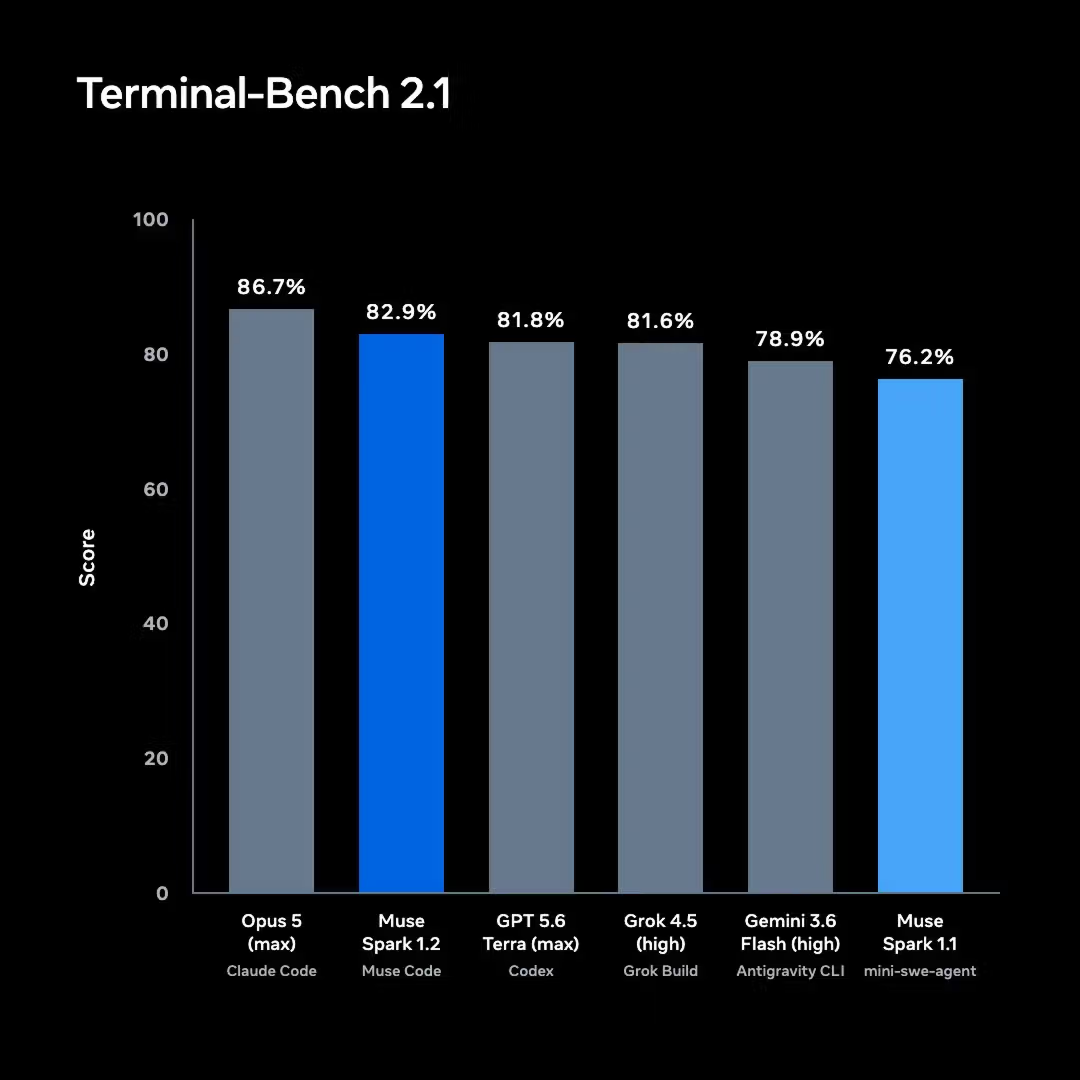
Meta’s published Terminal-Bench 2.1 chart. Beyond the top three, Grok 4.5 in Grok Build (81.6%) and Gemini 3.6 Flash in Antigravity CLI (78.9%) fill out the field — and the 1.1 → 1.2 jump is 6.7 points.
The price picture: three lanes
Per million tokens, the field sorts into lanes. Premium: Opus 5 at $5 in / $25 out and OpenAI’s flagship GPT-5.6 Sol at $5 / $30. Mid: Codex’s default GPT-5.6 Terra at $2 / $12 (after OpenAI’s July 30 price cut), Grok 4.5 at $2 / $6, Gemini 3.6 Flash at $1.50 / $7.50, GLM-5.2 at $1.40 / $4.40, and Muse standard at $1.25 / $4.25. Budget: MiniMax M3 at $0.60 / $2.40, DeepSeek V4 Pro at $0.435 / $0.87, and the new DeepSeek V4 Flash at $0.14 / $0.28. And then off the map entirely: Muse Contributor at $0.10 / $0.20 — cheaper than every open-weight option, in exchange for letting Meta learn from your sessions.
For agent workloads specifically, cached input is the number that compounds: repository context gets re-sent every turn, and Muse Contributor’s $0.002 cached rate and DeepSeek V4 Flash’s $0.0028 are in a class of their own. Opus 5 caches at $0.50 — 250x Contributor’s rate. Over a month of long sessions, the cache column is the bill; the mechanics are in our tier-math post.
What price and score tables miss
Three structural differences don’t fit in cells. First, harness ownership: Meta, Anthropic, OpenAI, xAI, and Google all ship first-party agents whose models are tuned for them — Muse Spark 1.2 was literally co-trained with Muse Code — while DeepSeek, GLM, and MiniMax ride third-party harnesses like OpenCode, which are excellent but generic. Second, openness: the Chinese trio publish weights, so you can self-host, fine-tune, and escape API pricing entirely — something none of the big three offer. Third, auditability: Muse Code’s replay-exact event log is currently unique as a first-class product feature, and for regulated teams it may outweigh single-digit benchmark deltas.
A decision framework
Maximum capability, price secondary — Claude Code + Opus 5, still the scoreboard leader. Frontier-adjacent capability at mid-market price, with parallelism and auditability as the differentiators — Muse Code, on standard for proprietary work or Contributor for everything else. Self-hosting, fine-tuning, or hard data-sovereignty requirements — the open-weight lane: DeepSeek V4 for price-performance, GLM-5.2 or MiniMax M3 depending on your harness and eval results. Deep OpenAI or Google ecosystem investment — Codex and Antigravity CLI remain the paths of least resistance, and Grok 4.5’s $6 output rate makes Grok Build the cheapest of the premium-lane agents.
And because the Model API is drop-in compatible with the SDKs and CLIs you already run, testing Muse against your incumbent costs one base-URL change. The numbers age fast in this market; the compare page carries the current table and its last-checked date. Trust your own diffs over anyone’s benchmark — ours included.